Disclaimer: The information in this article is for educational and informational purposes only. It is not intended to be a substitute for professional medical advice, diagnosis, or treatment. Always seek the advice of your physician or other qualified health provider with any questions you may have regarding a medical condition.
Smart ring sleep tracking is highly accurate for detecting general sleep duration and distinguishing when you are asleep versus awake, achieving over 95% sensitivity in clinical tests. However, they are less precise when classifying specific sleep stages (like REM, Deep, and Light sleep) compared to medical sleep studies.
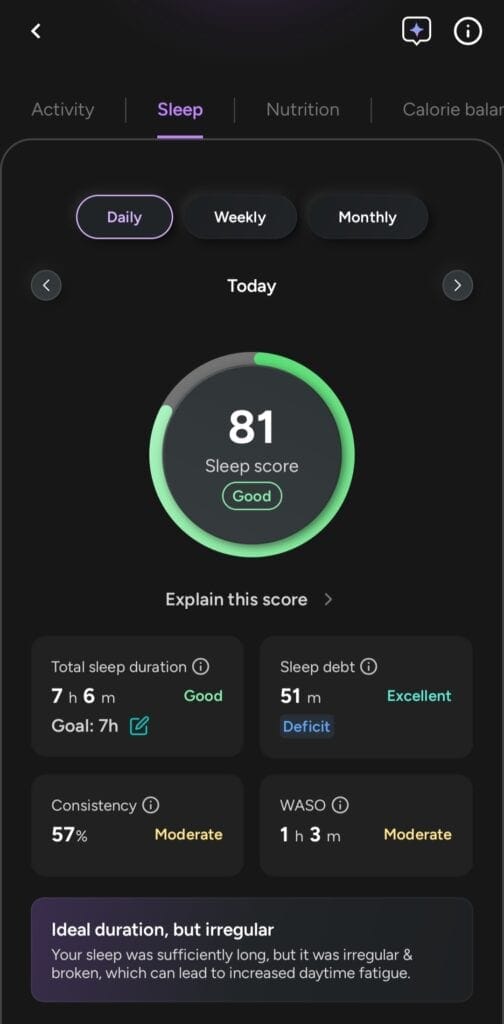
I have been wearing a smart ring to bed for the past several months, and I have compared the data it gives me against how I actually feel each morning. Some of it lines up perfectly. Some of it does not tell the whole story.
Here is what the clinical research says, how the sensors actually work, and where my own experience matches — and where it falls short.
How Do Smart Rings Track Your Sleep?
Smart rings track sleep by combining data from three sensors on your finger: an infrared PPG light that reads your heart rate, an accelerometer that detects body movement, and a temperature sensor that monitors skin heat changes throughout the night.
They do not read your brain waves. Instead, they estimate your sleep cycles by monitoring the physical signals your body gives off while resting.
Here is how each sensor contributes:
- Photoplethysmography (PPG) Sensors: These are the small infrared lights on the inside of the ring band. They shine light through your skin to measure the expansion and contraction of your blood vessels, tracking your heart rate, heart rate variability (HRV), and blood oxygen levels. This same PPG sensor is also what allows smart rings to track blood oxygen levels.
- 3-Axis Accelerometer: This sensor tracks your physical movements. It detects when you toss and turn, indicating periods of restlessness or wakefulness.
- Temperature Sensors: These sensors monitor changes in your skin temperature throughout the night, which naturally fluctuates as you enter different sleep phases.
By combining heart rate drops, HRV spikes, body movement, and temperature changes, the ring’s software algorithm estimates when you fell asleep, when you woke up, and which sleep stage you were in.
How Does Smart Ring Sleep Tracking Compare to Smartwatches and Sleep Studies?
Smart rings match clinical polysomnography (PSG) with 96% accuracy for detecting sleep versus wake, but they are significantly less accurate at classifying individual sleep stages like REM and Deep sleep.
Polysomnography (PSG) is the gold standard for sleep measurement. It is a clinical sleep study where a patient sleeps in a laboratory hooked up to brain-wave monitors (EEG), heart rate monitors (ECG), and breathing sensors.
A landmark validation study published in the peer-reviewed journal Behavioral Sleep Medicine (PMC6095823) compared the sleep data of the Oura Ring against PSG in a controlled group. The clinical data showed:
- Sleep/Wake Detection: The smart ring matched PSG with 96% sensitivity for detecting when a user was asleep. If you are asleep, the ring knows it.
- Total Sleep Time (TST): The ring was highly accurate in calculating total sleep duration, showing no statistically significant difference from the PSG readings.
- Sleep Onset Latency (SOL): The ring correctly identified how long it took users to fall asleep.
However, the study also revealed a limitation. The smart ring struggled to precisely classify specific sleep stages, tending to underestimate deep sleep and overestimate REM sleep in some individuals.
Newer software algorithms have improved these numbers (achieving around 79% overall agreement for four-stage staging in recent tests), but they still cannot match the accuracy of direct brain-wave monitoring.
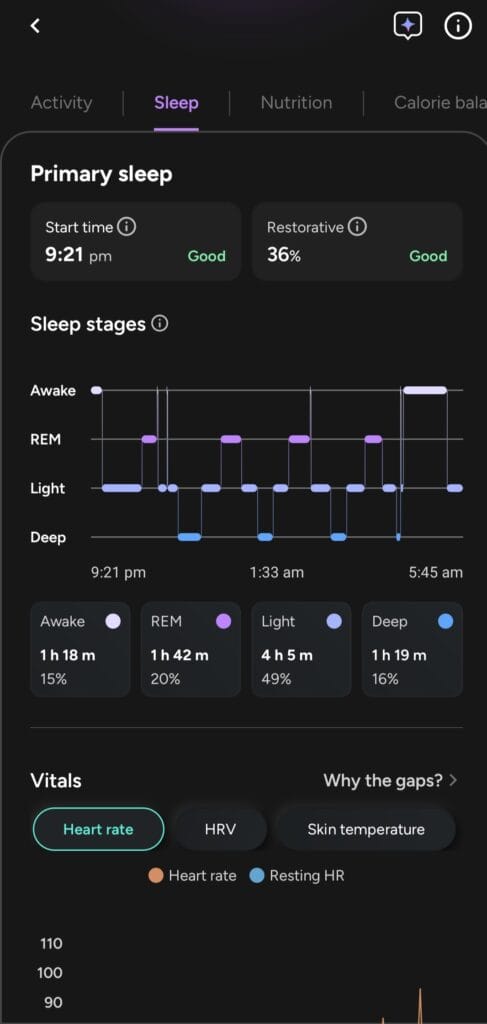
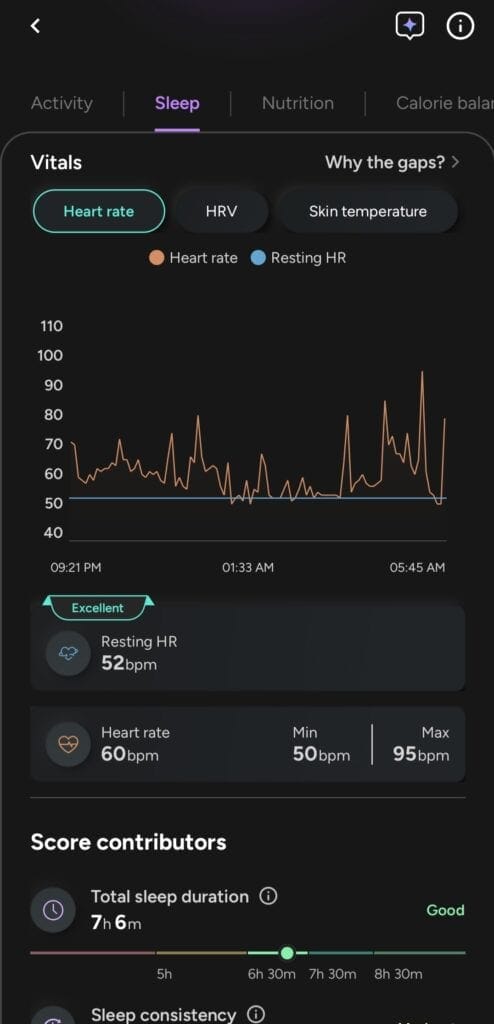
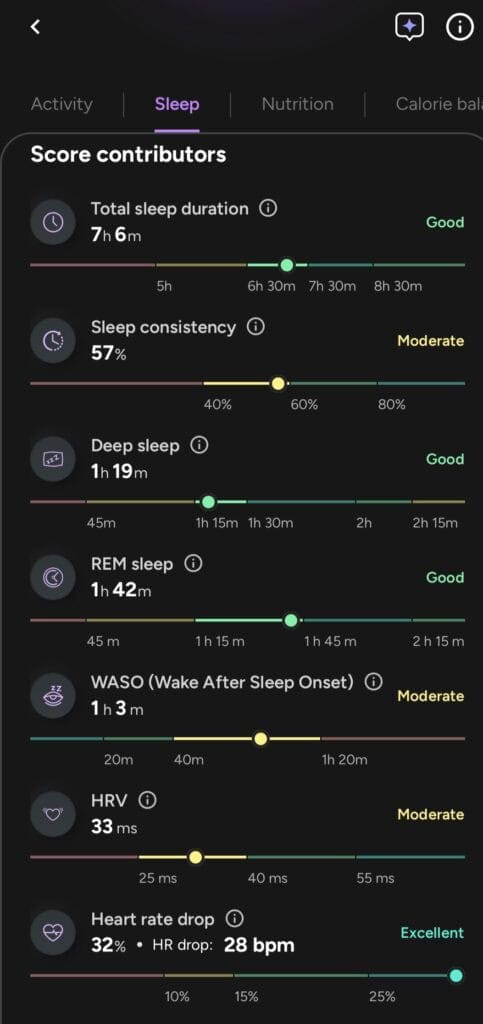
In my own data, I noticed my ring consistently shows around 1 to 1.5 hours of deep sleep per night. On mornings when I wake up feeling genuinely refreshed, that number tends to be higher. So while it may not match a lab test exactly, the trend tracking has been reliable for me.
How Do Smart Rings Compare to Smartwatches and Sleep Studies?
Smart rings outperform most smartwatches for sleep tracking accuracy because the finger provides a stronger, cleaner PPG pulse signal than the wrist. However, neither wearable can match the diagnostic precision of a clinical polysomnography study.
| Feature / Metric | Smart Ring (e.g., Oura, RingConn) | Smartwatch (e.g., Apple Watch, Garmin) | Clinical PSG (Sleep Lab Study) |
|---|---|---|---|
| Primary Sensor Location | Finger (Digital Arteries) | Wrist (Radial Artery) | Head (EEG), Chest (ECG), Face |
| Sleep / Wake Accuracy | Very High (~95%+) | High (~90%+) | 100% (Clinical Standard) |
| Sleep Stage Classification | Moderate to High (~79%) | Moderate to High (~70-80%) | 100% (Clinical Standard) |
| Physical Comfort | High (Lightweight, no screen) | Medium (Bulky, screen light) | Low (Tethered to wires) |
| Battery Life | 5–7 Days | 1–2 Days (Typically) | N/A (One-night test) |
| Medical Diagnostics | No (Trend tracking only) | No (Trend tracking only) | Yes (Diagnoses Sleep Apnea) |
I covered my full daily experience with wearing a smart ring — including comfort, battery life, and all the health metrics it tracks — in my smart ring health tracking review.
Is the Finger More Accurate Than the Wrist for Sleep Tracking?
Yes. The finger has blood vessels much closer to the skin’s surface than the wrist, giving smart ring PPG sensors a cleaner, stronger pulse signal with fewer motion artifacts during sleep.
A watch is heavy and can slip or rotate on your wrist when you turn over in bed. This movement creates “motion artifacts” that disrupt the sensors. A properly fitted smart ring stays locked securely in place, yielding much more consistent data throughout the night.
In my personal experience, wearing a ring is also far more comfortable. I used to track my sleep with a bulky sports watch, but the screen would occasionally light up when I rolled over, disrupting my rest. Switching to a screenless ring made sleep tracking passive and unnoticeable.
Can a Smart Ring Replace a Medical Sleep Study?
No, a smart ring cannot replace a medical sleep study and should never be used to self-diagnose a sleep disorder.
Smart rings are fantastic for tracking daily habits and identifying long-term trends — such as how alcohol, late-night meals, or stress impact your resting heart rate and sleep quality. But they cannot diagnose medical conditions.
A clinical PSG study measures actual brain activity (EEG) and muscle tone to identify disorders like sleep apnea, chronic insomnia, or restless leg syndrome. If you suspect you have a sleep disorder, you must consult a medical professional for a clinical evaluation.
When Do Smart Rings Get Sleep Tracking Wrong?
Smart rings can produce inaccurate sleep data when the ring fits loosely, when your hands are very cold, or when excessive movement disrupts the accelerometer.
Here are the most common failure points:
- Poor Ring Fit: If your ring is too loose, the sensors will lose contact with your skin, resulting in gaps in your heart rate and sleep stage data.
- Rapid Heart Rates or Arrhythmias: If you have an irregular heartbeat, the ring’s algorithms may struggle to interpret your HRV data correctly.
- Movement During Sleep: While minor tossing and turning is tracked, excessive movements (such as restless leg syndrome or sharing a bed with a restless partner) can fool the accelerometer into thinking you are awake.
- Cold Hands: When your hands are very cold, your blood vessels constrict (vasoconstriction), reducing blood flow to the fingers. This makes it difficult for the PPG sensor to read your pulse.
I have personally experienced the cold-hands issue. During winter, my ring occasionally shows gaps in my heart rate data during the first hour of sleep, likely because my fingers were too cold for the sensor to get a clean read. Wearing light gloves for the first 20 minutes usually fixes it.
Should You Trust Your Smart Ring’s Sleep Data?
You should trust your smart ring for relative trends, but not as absolute medical truth.
If your ring shows that your deep sleep has increased over the last month after you cut out caffeine, that trend is highly reliable and valuable. But if your ring tells you that you got exactly 42 minutes of REM sleep last night, treat that number as an educated estimate rather than an exact measurement.
By focusing on long-term trends rather than daily micro-metrics, you can use your smart ring’s data to make real, positive changes to your sleep hygiene.
FAQ
Yes. Clinical studies show that smart rings like the Oura Ring achieve over 95% sensitivity in distinguishing between sleep and wake states. However, they are less precise at distinguishing specific sleep stages (REM vs. Deep sleep) compared to clinical polysomnography, achieving around 79% agreement for four-stage sleep classification.
Smart rings use three sensors: a PPG (photoplethysmography) sensor that tracks heart rate and HRV through infrared light, a 3-axis accelerometer that detects body movement, and a temperature sensor that monitors skin heat changes. The ring’s algorithm combines these signals to estimate when you fell asleep, woke up, and which sleep stage you were in.
No. Smart rings are excellent for tracking long-term sleep trends and habits, but they cannot replace a medical polysomnography (PSG) sleep study. PSG measures actual brain waves (EEG) and muscle tone to diagnose disorders like sleep apnea, chronic insomnia, or restless leg syndrome. If you suspect a sleep disorder, consult a medical professional.